

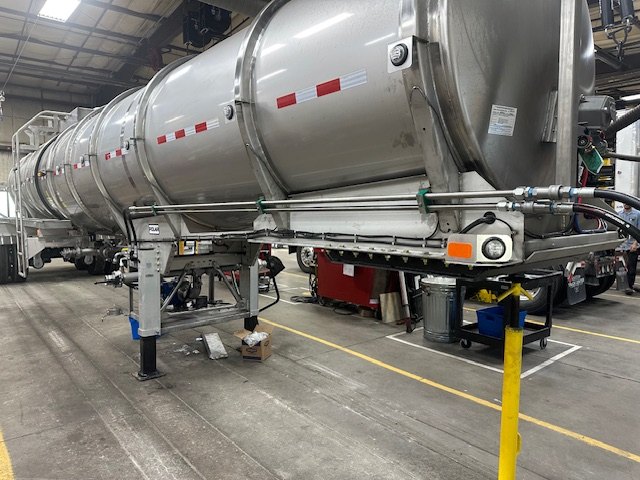
A tanker with a bad weld, a leaking valve, or a running-gear problem is a truck that shouldn’t roll. Ames Hydraulics does tanker trailer repair for fuel haulers, food-grade operators, chemical carriers, water and vac trucks, and dry-bulk pneumatic tanks across central Iowa. Tanks, plumbing, valves, DOT-compliant welds, and the running gear underneath. Free pickup within 60 miles of Ames.
What “Tanker Trailer Repair” Actually Covers
Most tanker trailer repair is either tank work, plumbing work, or running-gear work. Tank work is welding — cracks, dents, pitting, baffle repairs, and manway hardware. Plumbing work is valves, pumps, hoses, air-actuation, and the whole handling package on the rear. Running-gear work is axles, brakes, suspension, and the frame that ties everything to the truck. We do all three.
What We Repair
- Cracked tanks, seams, and heads — DOT-compliant welding on carbon steel, stainless, and aluminum
- Internal baffles and bulkheads — the sloshing you don’t want to feel in a turn
- Manways, vents, and hatch hardware
- Product valves, pumps, and hose reels
- Air-operated valves, actuators, and controls
- Running gear — axles, brakes, air-ride, springs, and frame
- Rear bumpers, ladders, catwalks, and platforms
Fuel Tankers, Food-Grade, Chemical, and Vac
Every tanker has its own rules. Fuel tankers need certified welds and pressure-tested compartments. Food-grade stainless has to be welded in a way that leaves a cleanable, non-porous surface. Chemical tanks may need specialty alloys or linings. Vac tanks — septic and industrial — live hard lives and see corrosion faster than most. Tanker trailer repair here is done to the standard the tank is inspected against, whatever that standard is. If you’re not sure what your tank is rated for, bring the paperwork and we’ll match the repair to the code.
Aluminum, Stainless, and Carbon Steel
Different tanker builds call for different welding. Fuel and petroleum tankers are usually aluminum for weight. Food-grade and chemical are usually stainless for cleanability and corrosion resistance. Vac and water trucks are usually carbon steel because they’re beat-up work vehicles. We weld all three every day and know when a repair calls for TIG versus MIG, and when a repair calls for a full section replacement rather than a patch.
Running Gear Is Half the Job
The tank gets all the attention, but the frame and axles underneath are where a lot of failures happen. Cracked frame rails, worn suspension hangers, worn spring pins, and beat-up axle hubs can all take a tanker out of service. We do the frame-and-suspension side of tanker trailer repair in the same visit — nothing gets sent out.
Free Pickup Within 60 Miles
If the tanker isn’t safe to move, we’ll come to it — free within 60 miles of Ames. Text a photo of the tanker and the problem to 515-292-2599 and we’ll tell you the same day what your tanker trailer repair needs and roughly what it will cost.
Get the Tanker Back on the Road
See our full hydraulic repair, welding & fabrication, and trailer repair services. Call or text 515-292-2599 or bring the tanker to 210 Freel Dr in Ames. Open Monday through Friday, 7AM to 5PM.
DOT Compliance and Certified Welds
Any tanker trailer repair that involves welding on a pressure-holding portion of the tank has to meet the code the tank was built to — DOT-406, 407, 412, MC-306, and so on, depending on the tanker and its service. That means the welder, the procedure, and the filler material all have to match. Ames Hydraulics does this work, and we do it in a way that will pass a re-certification inspection. If your tank is coming due for its five-year pressure test or its interior inspection, that’s the visit to schedule the structural work into.
Turn Time and Cost
Small welded repairs on a tanker are usually a same-day or next-day job. Larger structural work — a cracked head, a manway replacement, or a section replacement on the tank — runs longer, depending on parts and welding time. Running-gear tanker trailer repair is priced like any heavy-trailer service: axles, brakes, suspension, and frame at real hourly rates, no dealer markups. Every quote is in writing, up front.
Every Kind of Tanker We Service
Fuel and petroleum haulers (aluminum construction, typically DOT-406 or 407 compliant), food-grade stainless tankers hauling milk or edible oils, chemical tankers (specialty alloys or lined), vacuum trucks pulling septic or industrial waste, dry-bulk pneumatic tanks moving cement or fly ash, and water tankers on construction and dust-control jobs. Central Iowa runs all of them, and Ames Hydraulics services all of them. See the vacuum truck repair, water truck repair, and propane truck valve repair pages for tanker-specific service details.
Signs Your Tanker Needs Attention
- Product leak at manway, valve, or seam — gasket failure or cracked weld, either way not safe to run
- Sloshing you can feel in a turn — internal baffle failure
- Product pump slower than it used to be — pump wear or plumbing restriction
- Cracks at frame rails, hangers, or hitch — structural fatigue, welded repair before it worsens
- Coming due for 5-year DOT recertification — schedule the visit ahead of time
Frequently Asked Questions
Do you handle DOT recertification prep on tankers?
We do the welded structural repair and pressure-integrity work that a tanker needs to pass recertification. The actual DOT inspection is done by a certified inspector; we get the tank into condition to pass and document the repairs made. Coordinate the timing with your inspector and we’ll build the schedule around it.
Can you weld aluminum tanker walls?
Yes. Aluminum welding on fuel and petroleum tankers is one of our specialties — TIG for cleanability and structural integrity, with the correct filler for the alloy in your tank. Aluminum welding is a specific skill and we do it daily; not every shop can.
What about stainless food-grade tankers?
Yes. Stainless welded repair with the correct procedure for cleanable, non-porous finish is in scope. Food-grade tankers need welded repair that leaves no pits, no crevices, and no carbide precipitation zones — we know the difference between a repair that passes a swab test and one that doesn’t.
How long does a tanker repair take?
Small welded repairs — a manway gasket, a valve replacement, a single crack — are usually 1-2 days. Larger structural work (multiple cracks, section replacement, head repair) runs 3-7 days. Full running-gear service adds a day or two on top. We quote realistic completion dates, not optimistic ones.
Do you service vacuum trucks and dry-bulk trailers as tankers?
Yes — vacuum trucks and dry-bulk (cement, fly ash) trailers are handled here alongside conventional liquid tankers. They share the same welded steel construction and similar plumbing failure modes. See the vacuum truck repair page and concrete blower repair page for those specifics.
Related Services

Written by Josiah Ragsdale
Owner, Ames Hydraulics — Ames, Iowa
Josiah owns and operates Ames Hydraulics. He has worked on hydraulic and heavy equipment since he was 18, and every hydraulic cylinder his shop rebuilds is pressure tested before it ships back to the customer. More about Josiah →
Got something broken? Call or text 515-292-2599