

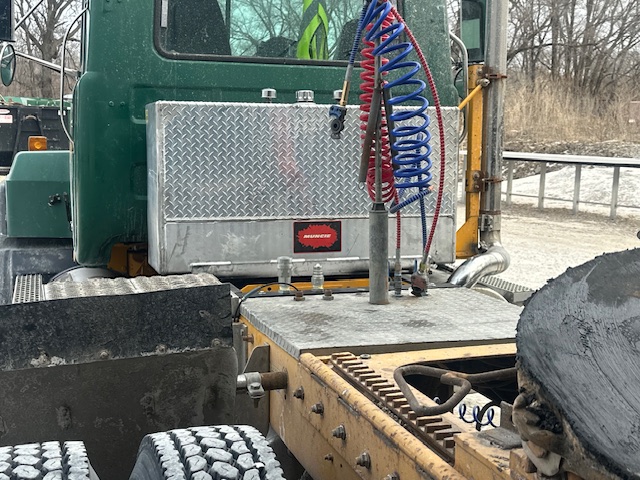
Wet Kit For Semi Installation in Central Iowa
If you haul a dump trailer, a walking floor, or a live-floor trailer, the hydraulics have to come from somewhere — and that somewhere is a wet kit for semi mounted on the tractor. At Ames Hydraulics in Ames, Iowa, we install complete wet kit systems on day-cab and sleeper tractors for owner-operators and fleets all over Central Iowa. A wet kit is not a bolt-on accessory you slap on in an afternoon. It is a real hydraulic system, and it needs to be plumbed, mounted, and pressure-checked by someone who works on hydraulics every day. That is what we do.
A wet kit for semi is the package of components that lets your tractor power the cylinder on a trailer. The power comes off the transmission through a PTO — a power take-off gearbox that bolts to an opening on the transmission and drives a hydraulic pump. From there the system needs a reservoir to hold the oil, the pump itself, a control valve, and the hoses and fittings that tie it all together. Get any one of those pieces wrong and the whole setup runs hot, runs slow, or does not run at all.
What Goes Into a Wet Kit Installation
Every install of a wet kit for semi starts with the truck and the work it has to do. A grain hauler running a dump trailer has different needs than an operator pulling a walking-floor trailer all day. We size and mount the major components to match:
- PTO. The power take-off is the heart of the system. We spec the right Chelsea or Muncie PTO for your transmission and the load, with the shift type — cable, air, or electric — that fits your cab.
- Pump. Most dump applications run a gear pump. Heavier continuous-duty work like a live-floor or walking-floor trailer often calls for a piston pump, which runs higher pressure and needs a case-drain line back to the tank.
- Reservoir. We mount a steel, aluminum, or poly tank in the right size and location for your frame — upright, saddle, or side-mount.
- Valve and controls. The control console goes in the cab where you can reach it, plumbed so the trailer raises, holds, and lowers the way it should.
- Lines and fittings. Pressure, return, and where needed a case-drain line, run clean and routed so nothing chafes or kinks.
2-Line and 3-Line Wet Kits
The most common question we get on a wet kit for semi is whether to run a 2-line or a 3-line setup. The difference is straightforward. A 2-line wet kit has a pressure line and a return line. It works fine for a lot of dump trailers, as long as the operator does not leave the PTO engaged in neutral — do that and the oil has nowhere to circulate, heat builds up, and the pump pays for it. A 3-line wet kit adds a dedicated return line straight back to the reservoir. That keeps oil circulating and cooler, lets the trailer lower faster by cutting restriction, and lets you run a return filter. For piston-pump applications and anything that runs continuously, the 3-line is the right call. We will tell you honestly which one your operation needs before we quote it.
We install both. If you already know you want a 3-line wet kit for a walking-floor trailer, or a simpler 2-line setup for an occasional dump load, we build it to suit. If you are not sure, that is what the phone call is for.
Who We Install Wet Kits For
Our customers for a wet kit for semi are people whose trucks make them money — grain and aggregate haulers, construction outfits, owner-operators picking up dump or walking-floor work, and fleets standardizing their tractors. When you search for a wet kit installer near me, you usually get a list of shops that will sell you a kit in a box and leave the install to you. We are not that. We are the shop that mounts it, plumbs it, and hands the truck back ready to work. A tractor trailer wet kit done right is one you never have to think about again, and that only happens when the install is done by someone who understands the hydraulics, not just the bolt pattern.
Why Bring Your Truck to Ames Hydraulics
We are a full hydraulic shop first, and that matters for a PTO wet kit. We build and repair hydraulic cylinders, hoses, and pumps in-house, so when we plumb a system we know exactly how it is going to behave under load. We give you a price up front, we answer the phone when you call, and we turn the work around fast because we know a parked tractor is not earning. If you would rather not make the drive, we offer free pickup and delivery within 60 miles of Ames.
If you have been looking for a semi truck wet kit done right — sized correctly, mounted clean, and tested before it leaves — you have found the shop. We also sell the kits themselves if you want to see options first; take a look at our wet kits for sale, and if your tractor needs other work done at the same time, our truck upfitting service can handle it in the same visit. Call or text Ames Hydraulics at 515-292-2599, or bring the truck by 210 Freel Dr, Ames, IA 50010, Monday through Friday, 7AM–5PM. Got a trailer that needs power? Let us get a wet kit for semi on it.
Serving the Des Moines metro? See our page on wet kit installation in Des Moines.
Related: Wet Kit Types: Single, 2-Line & 3-Line Explained
What to Expect From a Professional Wet Kit Installation
A proper wet kit installation is a full day’s work done right, not a rushed afternoon job. When your tractor comes in, we confirm the transmission and PTO opening, the trailer it has to run, and where the tank and controls should live for your cab and frame. From there the wet kit installation follows a set order: mount the PTO and pump, set the reservoir, plumb the pressure, return, and case-drain lines, route the shift control into the cab, and fill the system with the correct oil. Nothing gets signed off until we run it under load and confirm the trailer raises, holds, and lowers cleanly. Most single-tractor jobs are a one-day turnaround, and we give you the timeline in writing before we start so you can plan around the downtime.
Wet Kit Installation Sized to Your Trailer
No two operators run the same setup, so every wet kit installation is matched to the trailer and the work it does. A grain hauler on a dump trailer runs a gear pump and a straightforward 2-line arrangement; a walking-floor or live-floor operator needs a piston pump, higher pressure, and a case-drain line back to the tank. Belt trailers, blowers, and other continuous-duty gear each change the pump, tank size, and valve we spec. Matching those pieces to your load is the whole point of a professional wet kit installation — an undersized pump or reservoir runs the system hot and slow, while an oversized one just wastes fuel and money.
Common Wet Kit Installation Questions
How long does a wet kit installation take? Most are a one-day job on a single tractor; fleets we schedule in batches so trucks cycle through without stacking up downtime. Can you move a system to a new truck? Yes — we regularly pull a wet kit off a traded tractor and reinstall it on the new one, which is often far cheaper than an all-new kit. Will it work with my trailer? Bring the trailer and the transmission details and we’ll match the wet kit installation to exactly what you pull. Do you service what you install? Yes — pumps, valves, cylinders, and leaks all get handled on our own hydraulic bench, so the shop that did your wet kit installation is the same one that keeps it running for years.
2-Line vs 3-Line Wet Kit Installation — Which One You Actually Need
One of the most common questions we get on a wet kit installation quote is 2-line vs 3-line. The short version: a 2-line wet kit runs a pressure line to the trailer and a suction line back, and drives one trailer function — typically a dump body or a live-floor. A 3-line wet kit adds a case-drain line and unlocks bidirectional or higher-flow trailer applications: end-dump plus wet-line-blower, walking floors that need continuous pump duty, or hydraulic-motor-driven attachments on the trailer. If your work is straight dump service, 2-line is usually right. If you’ll ever pull a walking floor, live-bottom, or a trailer with a hydraulic-motor attachment, 3-line is worth the extra cost up front — retrofitting from 2-line to 3-line later means running a new hose across the whole truck.
Real Wet Kit Installation Cost In 2026
Honest pricing on a wet kit installation at our shop lands in a range, not a single number, because the truck matters more than most operators think. A clean 2-line install on a Peterbilt or Kenworth with a factory PTO opening runs on the lower end — less shop time to route hoses, less cutting for the reservoir mount. A 3-line install on a truck that needs a wet-side PTO added, custom reservoir mounting to clear the fuel tanks, and hose routing around aftertreatment adds hours. The pump, PTO, valve, reservoir, and hose material cost themselves are a smaller share of the total than the labor to fit them cleanly. We give a written estimate before we start, so there are no surprises when you pick the truck up.
The Wet Kit Installation Process — Start To Finish
A typical shop-completed wet kit installation runs one to two full shop days. Day one: PTO fitment (drop the transmission cover, install the PTO, torque to spec, seal), pump mount and drive-line, reservoir placement and mounting, hose routing planning. Day two: valve installation in the cab or on the frame rail, hose runs (pressure, suction, and case-drain if 3-line), electrical for the in-cab controls, fluid fill and system bleed, pressure test at working PSI, function test with a shop-simulator or a hooked-up trailer, and a road-test verification if the customer wants it. Every wet kit installation we finish gets a written spec sheet with pump displacement, working PSI, PTO gear ratio, and reservoir capacity — so the customer has the numbers for future service.
The reason a shop-completed wet kit installation beats a roadside or garage-DIY job is not just the tooling — it’s the ability to pressure-test under controlled conditions before the truck leaves. We push the system to full working PSI on a hydraulic dead-head and watch for weeps, listen for pump cavitation, and correct hose routing before any of it becomes a road failure. That final pressure test is the difference between a wet kit that runs clean for five years and one that leaks in month three.
Wet Kit Installation — By Truck Brand, Trailer Type, And City
Wet kit installation is one of our specialty jobs. Below is the map of related pages — by truck brand for the install itself, by trailer type for spec’ing the hydraulic package, and by city for local coverage.
Wet Kit Installation By Truck Brand
- Wet kit installation on a Peterbilt
- Wet kit installation on a Kenworth
- Wet kit installation on a Freightliner
- Wet kit installation on a Mack
- Wet kit installation on an International truck
Wet Kit Installation By Trailer Type
- Wet kit installation for a dump trailer — single-line install
- Wet kit installation for a walking floor trailer — two-line install
- Wet kit installation for a live bottom trailer — three-line piston pump install
- Wet kit installation for a blower trailer — heavy-duty three-line install
Wet Kit Cost And Info
- Wet kit installation cost on a semi
- Wet kit install cost guide — 2026 price breakdown
- 2-line vs 3-line wet kit — which one fits your trailer
- What is a wet kit on a semi
Wet Kit Installation By City (Central Iowa)
- Wet kit installation Des Moines
- Wet kit installation Ankeny
- Wet kit installation Boone
- Wet kit installation Story City
- Wet kit installation Nevada
- Wet kit installation Marshalltown
- Wet kit installation Grimes
- Wet kit installation Waukee
- Wet kit installation Johnston
- Wet kit installation Newton

Written by Josiah Ragsdale
Owner, Ames Hydraulics — Ames, Iowa
Josiah owns and operates Ames Hydraulics. He has worked on hydraulic and heavy equipment since he was 18, and every hydraulic cylinder his shop rebuilds is pressure tested before it ships back to the customer. More about Josiah →
Got something broken? Call or text 515-292-2599