

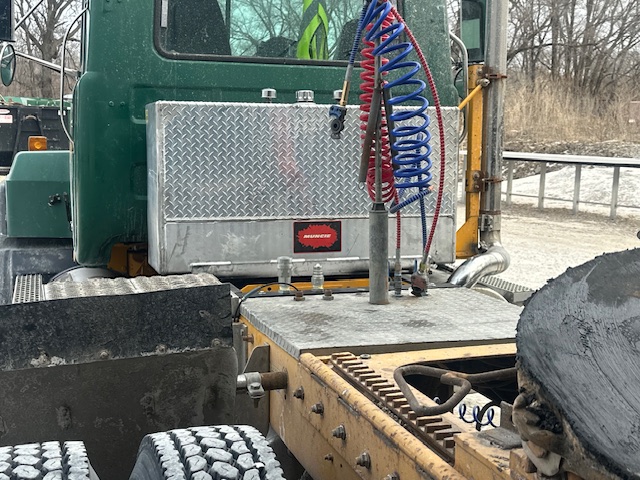
What Is a Wet Kit on a Semi?
Ask a few drivers and you’ll get a few different answers, so let’s clear it up. The short version of what is a wet kit on a semi is this: it’s the hydraulic system mounted on the truck that powers a trailer or body that has to move under hydraulic pressure. Think dump trailers, walking-floor trailers, live-bottom trailers, and detachable lowboys. The trailer has the cylinder; the truck needs the pump, the tank, and the power to run it. That package on the truck is the wet kit.
At Ames Hydraulics in Ames, Iowa, we build and install these systems for haulers, farmers, and fleets across Central Iowa, so we field this question a lot. Here’s the full picture.
The Parts of a Wet Kit
When somebody asks what is a wet kit on a semi made of, it comes down to a handful of components that work together:
- PTO (power take-off). This bolts onto the side of your transmission and taps engine power off the gearbox. Chelsea and Muncie are the common names here. The PTO is what turns the pump.
- Hydraulic pump. Driven by the PTO, the pump turns that mechanical power into hydraulic pressure. On dump applications this is often a dump pump; other jobs use a gear or piston pump.
- Reservoir (the “wet” tank). This holds the hydraulic oil. The tank full of oil is a big reason the system is called “wet” in the first place.
- Control and valving. An air shift or a cab control lets the driver engage the PTO and run the system without leaving the seat.
- Hoses and fittings. These carry the pressurized oil from the pump out to the trailer through couplers at the back of the truck.
How It Works in Plain Terms
You pull up, you engage the PTO, and the pump starts moving oil under pressure. That pressurized oil runs back through the hoses to a coupler, then into the trailer’s cylinder. The cylinder extends and raises the dump body, or it drives the floor on a walking-floor trailer. When you’re done, oil returns to the reservoir on the truck. Knowing what is a wet kit on a semi at this level helps you understand why the truck and the trailer have to be matched: the truck supplies the muscle, and the trailer puts it to work.
2-Line and 3-Line Setups
You’ll hear the terms two-line and three-line. A two-line system runs a pressure line and a return line. A three-line adds a dedicated case-drain line so the oil circulates back to the tank to stay cooler and so a filter can sit on the return. Three-line setups generally run cooler and hold up better in heavy, repeated cycling, which matters a lot for an operator dumping load after load. Which one is right for you depends on how hard and how often you run.
Who Needs One
If your trailer has a hydraulic cylinder and your truck doesn’t already have hydraulics, you need a wet kit to make the two work together. Common cases around Central Iowa include:
- Grain and aggregate haulers running dump trailers.
- Operators with walking-floor trailers moving mulch, grain, or scrap.
- Construction outfits pulling end-dumps or detachable lowboys.
- Anyone buying a used trailer for a truck that came without a kit.
If you swap between trailers, we can set the truck up with the couplers and controls to run more than one, so understanding what is a wet kit on a semi also means thinking about which trailers it has to feed.
Matching the Kit to Your Truck
The PTO has to match your exact transmission, whether that’s a manual Eaton Fuller, an automated, or an Allison automatic. The pump flow has to match the trailer’s cylinder so it raises at a safe, usable speed. The tank has to be sized for the system. Get any of that wrong and you get slow cycles, overheating oil, or a PTO that won’t engage right. That’s why this isn’t a parts-store guess job. We spec the whole system to your truck and the work you do, then build it to hold up.
Get Your Wet Kit Built Right in Ames
Now that you know what is a wet kit on a semi, the next step is getting one spec’d and installed correctly. Ames Hydraulics installs wet kits for working operators all over Central Iowa, and we give you a price up front before the work starts. Call or text us at 515-292-2599, or bring the truck to 210 Freel Dr, Ames, IA 50010, Monday through Friday, 7AM–5PM. We offer free pickup and delivery within 60 miles. See our full wet kit installation page for details, and if you want to dig into the systems, read our breakdown of 2-line vs. 3-line wet kits.

Written by Josiah Ragsdale
Owner, Ames Hydraulics — Ames, Iowa
Josiah owns and operates Ames Hydraulics. He has worked on hydraulic and heavy equipment since he was 18, and every hydraulic cylinder his shop rebuilds is pressure tested before it ships back to the customer. More about Josiah →
Got something broken? Call or text 515-292-2599