

What Drives Wet Kit Install Cost in 2026
If you run a dump trailer, a walking floor, a live-bottom, or any trailer that needs hydraulics off the truck, sooner or later you start pricing out a wet kit. And the first thing you find is that nobody wants to give you a straight number. There’s a reason for that. The honest answer to what a wet kit install cost looks like is that it varies, because no two trucks and no two operations are set up the same way. This guide walks through the real factors that move the price so you can budget like someone who knows what they’re paying for.
At Ames Hydraulics in Ames, Iowa, we install wet kits on semis for farmers, haulers, and fleets across Central Iowa. We’re not going to quote you a flat rate sight unseen, because that’s how you end up with surprises. Instead, here’s what actually goes into the number.
The Components Themselves
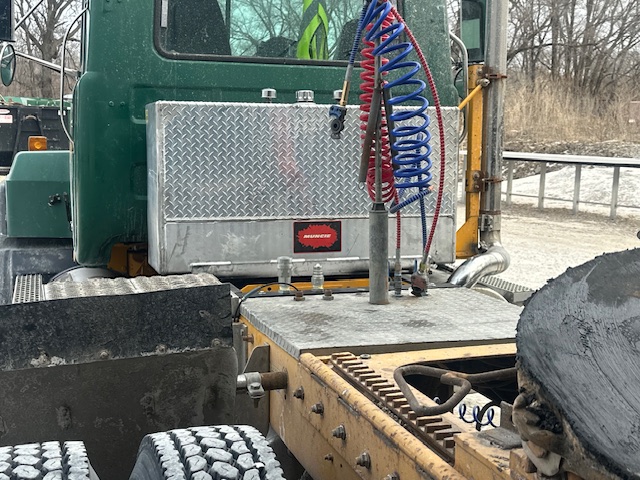
A wet kit is a package of real hardware, and the parts list is the biggest single piece of the cost. A typical kit includes a PTO (power take-off) that bolts to the transmission, a hydraulic pump driven by that PTO, a hydraulic reservoir or tank, a control valve or air shift to run it from the cab, and the hoses, fittings, and mounting hardware that tie it all together. Component makers like Chelsea, Muncie, and Parker build these parts, and there’s a wide spread in price depending on flow rate, pump type, and reservoir size. A bigger pump and a larger tank cost more, plain and simple.
2-Line vs. 3-Line Setup
One of the biggest factors in your wet kit install cost is whether you go with a two-line or a three-line system. A two-line setup uses a pressure line and a return line. A three-line setup adds a dedicated case-drain line that lets the oil circulate back to the reservoir to stay cooler and lets you run a filter on the return. Three-line kits use more hose, more fittings, and more labor to plumb, so they cost more up front. They also tend to run cooler and last longer in heavy-cycle work, which is why a lot of operators choose them anyway. We’ll walk you through which one fits your trailer.
Your Truck and Transmission
What you’re bolting all this to matters a lot. The PTO has to match your specific transmission, whether that’s an Eaton Fuller manual, an automated, or an Allison automatic. Some transmissions take a PTO easily; others need a different aperture, a different gear, or extra clearance work. Cab and frame layout also affect how hard it is to route hoses and mount the tank. A clean, roomy chassis installs faster than a tight one packed with DEF tanks, battery boxes, and air lines, and labor time is a real part of any wet kit install cost.
New Build vs. Swap or Repair
Putting a fresh kit on a truck that has never had one is different from swapping a worn-out kit or repairing a setup somebody else plumbed wrong. On a fresh build, we’re mounting everything from scratch. On a repair or upgrade, we may reuse the reservoir or the PTO and just replace the pump, the valve, or the hoses. That changes the parts bill and the labor, so the wet kit install cost on a repair is usually different from a full new install.
Options That Add Up
Plenty of extras can ride along with the base kit:
- Reservoir size and material. A bigger tank or an aluminum tank costs more than a small steel one.
- Wet kit for the trailer side. If you swap between trailers, you may want quick-connect couplers and matching plumbing on each trailer.
- In-cab controls. Air-shift PTO engagement and a cab-mounted control are more convenient than a manual setup, and they add parts.
- Filtration and gauges. A return filter, a temperature gauge, or a pressure gauge are cheap insurance that add a little to the total.
None of these are required, but each one nudges the number. We tell you what’s worth it for how you actually run and what’s just nice to have.
Why We Quote Instead of Posting a Price
You’ll see shops and forums throw out rough ranges, but a real wet kit install cost depends on the kit you pick, your transmission, and the condition of the truck. We give you a price up front, before any work starts, so there are no surprises when you come to pick it up. Bring the truck by, tell us what you haul and how hard you run it, and we’ll spec the right kit and put a real number on it. That’s a far better way to budget than guessing off a number that was never meant for your rig.
Get a Real Quote from Ames Hydraulics
We’ve been plumbing hydraulics and building trucks for working operators around Central Iowa for years, and we’ll tell you straight what a wet kit install cost looks like for your specific setup. Call or text us at 515-292-2599, or bring the truck to 210 Freel Dr, Ames, IA 50010, Monday through Friday, 7AM–5PM. We offer free pickup and delivery within 60 miles of Ames. Want the full rundown on the install itself? See our wet kit installation page, and if you’re still deciding between systems, read up on 2-line vs. 3-line wet kits first.

Written by Josiah Ragsdale
Owner, Ames Hydraulics — Ames, Iowa
Josiah owns and operates Ames Hydraulics. He has worked on hydraulic and heavy equipment since he was 18, and every hydraulic cylinder his shop rebuilds is pressure tested before it ships back to the customer. More about Josiah →
Got something broken? Call or text 515-292-2599