

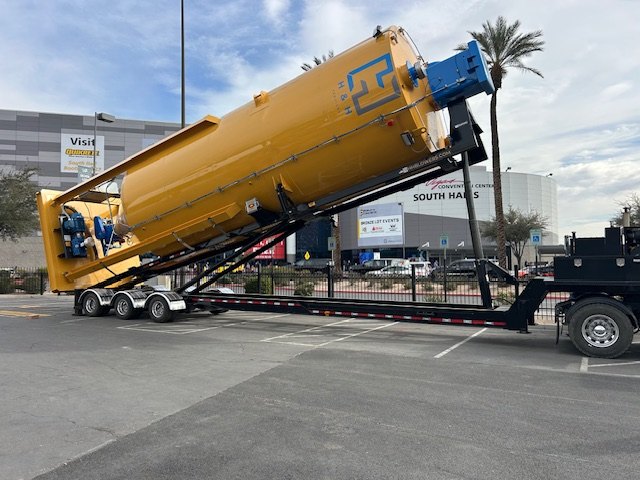
Not every operation needs a 7,500-cubic-foot vertical silo. Contractors moving between jobsites, small ready-mix operators serving a limited area, precast yards without a permanent pad, and remote projects all need a smaller, mobile portable silo — smaller footprint, smaller pad, easier to move. Ames Hydraulics sells the LoPro portable silo line in central Iowa. Free jobsite visits within 60 miles of Ames.
What a LoPro Portable Silo Is
The LoPro is a portable silo designed for smaller trucks and mobile jobsites. Lower overall height than a vertical crane-up silo, sits on a smaller pad, and can be moved between locations without cutting into the pad the way a permanent vertical silo does. For a contractor who works out of a rented yard, a small ready-mix operator, or a precast yard that reorganizes every couple of years, a LoPro-style portable silo is often the right choice.
Who Buys a Portable Silo
- General contractors pouring concrete on their own jobsites without buying ready-mix delivered
- Small ready-mix operators serving a limited local market
- Precast operators without a permanent yard, or with a yard that reorganizes
- Remote construction projects where trucking finished ready-mix in isn’t practical
- Backup capacity at a larger operation whose main silos are undersized during peaks
Portable Silo Sizing — What Fits
Sizing a portable silo is about matching capacity to your daily pour rate. If you’re pouring 20 yards a day, you don’t need a 7,500 CF silo — you need enough capacity to smooth deliveries and avoid running out. A rough sizing rule: 1 to 2 days of production capacity, so you’re not chasing cement deliveries every morning. We’ll walk through your actual pour rate before we quote a specific unit.
Portable Silo Install
Portable silo install is a lot simpler than a large vertical install — smaller pad, no crane-up, and typically the silo can be set in a day. We handle:
- Site walk and pad specification — we tell you what the pad has to be before you pour it
- Delivery coordination with the manufacturer
- Setting the silo and confirming it sits level and stable
- Pneumatic fill plumbing from delivery trucks
- Discharge feeder — airlock, auger, or gravity as your operation uses
- Dust collection integration if you’re pulling permits that require it
- Startup testing before we hand it over
Used Cement Silos
We occasionally have used portable silo units through our used-equipment channel — buy-and-sell inventory turns quickly and the specific model isn’t always the same. If you’re price-sensitive and open to a used unit, tell us that up front and we’ll let you know when something comes in that matches what you need. New units from the factory are the reliable answer when timing matters.
Service After the Sale
The reason to buy a portable silo through Ames Hydraulics rather than direct is the local service side. When a valve sticks, a hatch leaks, or the coating starts to fail, we’re in central Iowa — not a state away. See the silo repair page for the service side.
Related: Blowers, Dust Collection, Flow Bins
A portable silo is often the first piece of a small bulk-handling system. See dry bulk blower sales for the pneumatic conveying side, dust collector for emissions compliance, and flow bin for additive metering.
Get a Portable Silo Quote
Call or text 515-292-2599 or bring your site plan to 210 Freel Dr in Ames. We’ll walk through your pour rate, your pad situation, and the right portable silo size for your operation. Open Monday through Friday, 7AM to 5PM.
LoPro Versus Full-Vertical — the Real Trade-Off
The single most useful conversation before you buy a portable silo is LoPro versus full vertical. LoPro wins when you move the silo more than once every couple of years, when your pad is small or on rented ground, or when the truck approach angles won’t work with a taller unit. Full vertical wins when the silo is going in for good, when total capacity matters more than mobility, and when the pad and infrastructure justify the bigger install. We’ll walk through both with you honestly — not push one because the margin is better.
Pad Requirements
Every portable silo install starts with the pad, and the pad has to be right. A poorly-poured or undersized pad will let the silo shift under load and eventually crack the steel legs where they anchor. We spec the pad size, the concrete PSI, and the anchor pattern before you pour so the whole install lands cleanly. If you’re pouring the pad yourself, ask us for the spec first — a bad pad is the most common reason a portable silo install gets delayed.
Winter and Cold-Weather Operation
Central Iowa winters are real, and a portable silo pouring cement in January has a couple of extra considerations. Cement flow can slow in cold weather, and moisture condensing inside the silo can cake product against the walls if the silo isn’t well ventilated. Some operators run a small heater in the discharge cone during the coldest months; others insulate the outside. We’ll walk through your winter operation and spec the silo accordingly.
Related Services

Written by Josiah Ragsdale
Owner, Ames Hydraulics — Ames, Iowa
Josiah owns and operates Ames Hydraulics. He has worked on hydraulic and heavy equipment since he was 18, and every hydraulic cylinder his shop rebuilds is pressure tested before it ships back to the customer. More about Josiah →
Got something broken? Call or text 515-292-2599