

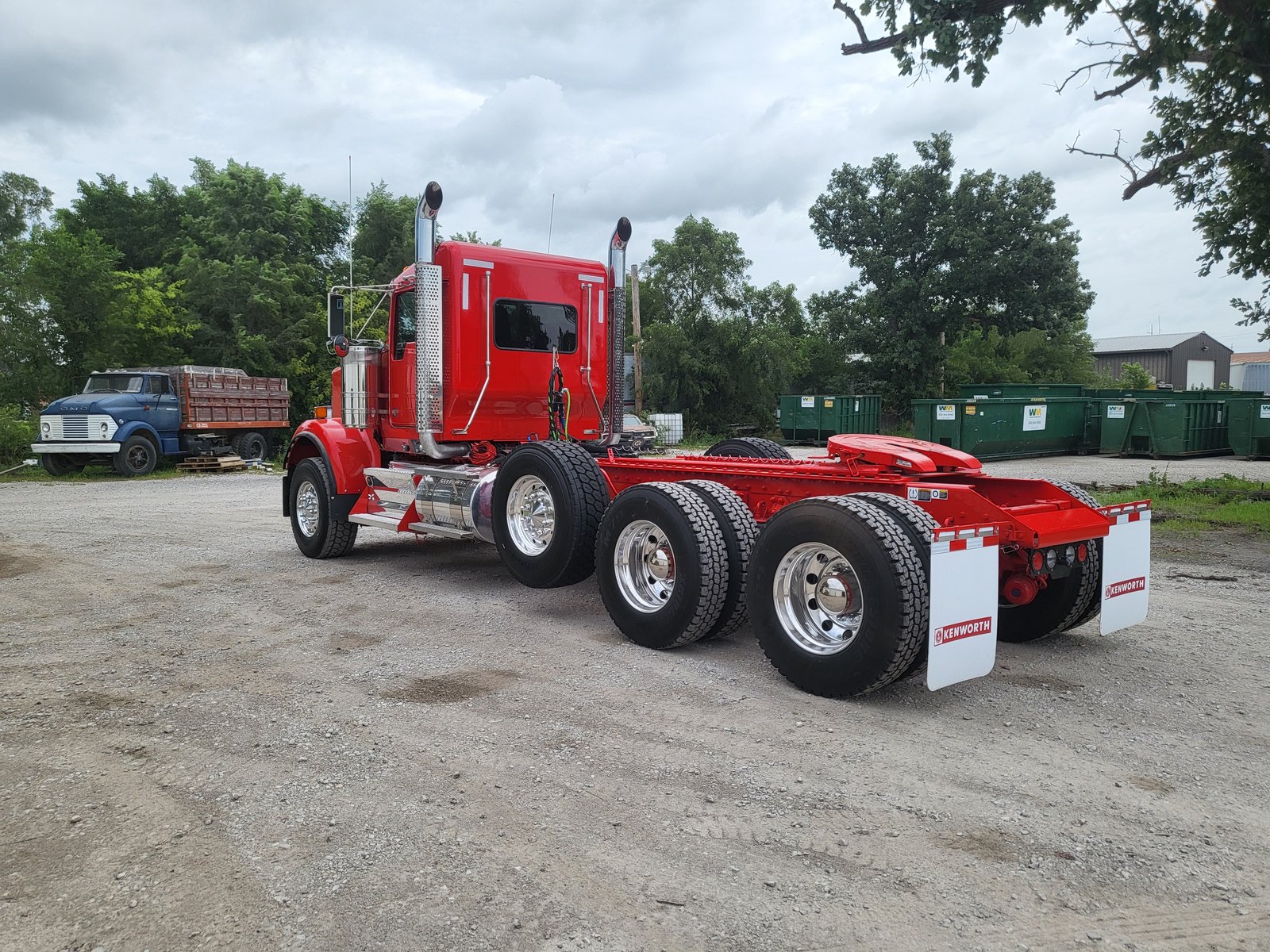
If you’re pricing a wet kit for your semi, you’ve probably gotten quotes that range from “suspiciously cheap” to “more than the truck payment” — with nobody explaining the difference. This is the honest cost breakdown we give customers at Ames Hydraulics, where wet kit installation on semis is one of our core services for central Iowa owner-operators hauling end dumps, walking floors, belly dumps, and live-bottom trailers.
The Short Answer
A professionally installed wet kit on a semi tractor in 2026 typically runs $3,500 to $7,500 all-in — parts and labor. The spread comes down to the system type, the pump and PTO the truck needs, tank size and mounting, and how much custom fabrication your frame layout requires. Anyone quoting far below that range is leaving something out — usually the mounting fabrication, the fluid, or the testing.
Single-Line, Two-Line, or Three-Line
System type is the biggest price driver. A single-line (dump) system — pressure line only, gravity return through the same line — is the simplest and cheapest, fine for a basic end dump: figure the lower end of the range. A two-line system adds a dedicated return line, runs cooler, and handles walking floors and higher-duty-cycle trailers: mid-range. A three-line system adds a case drain for trailers running hydraulic motors (walking floors, live bottoms, blowers): upper end. Buying more system than your trailer needs wastes money; buying less cooks the oil. We spec the wet kit to the trailer you actually pull.
Where the Money Goes
- PTO (power take-off): $400–$1,200 depending on your transmission — manual, automated manual, or automatic. Some automatics need specific PTO apertures and provisions that add cost.
- Hydraulic pump: $500–$1,500. Gear pumps for dump work; piston pumps for high-duty-cycle systems.
- Reservoir tank: $400–$1,000 for 30–70 gallon, aluminum or steel, side-mount or behind-cab — mounting location drives fabrication time.
- Hoses, quick-couplers, valves, filter: $400–$900, all assembled in-house.
- Controls: in-cab PTO switch and valve controls, $150–$500.
- Labor and fabrication: $1,200–$2,500 — mounting brackets, driveline work if the PTO is shaft-driven, plumbing routed and clamped so it doesn’t chafe, fluid, and full testing under load.
What Changes the Price on YOUR Truck
Three questions decide where your wet kit lands in the range. What transmission do you have? (PTO fitment is the wildcard — bring us the transmission tag numbers.) What trailer are you pulling now, and what might you pull in two years? (A two-line system now beats ripping out a single-line later.) And where can the tank live? (A clean frame rail means simple mounting; a crowded rail with a DEF tank, battery box, and fairings means fabrication time.) Send photos of both frame rails and your transmission tag to 515-292-2599 and we’ll quote it without the truck leaving your yard.
Why Not the Cheap Install?
We fix a lot of cheap wet kits. The usual sins: hoses routed against sharp frame edges that chafe through in a season, no return filter so the tank fills with grit, undersized single-line plumbing on a walking floor that cooks the oil, and tanks hung on unbraced brackets that crack at the weld. A wet kit done right is boring for years; a cheap one is a service call every season. The difference in up-front cost is usually under a thousand dollars — the difference in five-year cost is several times that.
Turnaround and What You Get
A standard installation is 2–3 days in our shop; complex mounts or driveline PTOs run 4–5. Every install leaves with the system run under real load, every fitting checked hot, the PTO engagement verified through its full cycle, and a walkthrough of operation and maintenance. For the full system explainer — what a wet kit is and how the pieces work together — see our wet kit for semi page. Call or text 515-292-2599 or stop by 210 Freel Dr in Ames. Open Monday through Friday, 7AM to 5PM.
Used Trucks: Inheriting Someone Else’s Wet Kit
Buying a used tractor that already has a wet kit? Budget for an inspection before you trust it with a loaded trailer. The common inheritance problems: oil that’s never been changed and is full of moisture, a tank breather packed with grain dust, hoses at the end of their life, and a pump that’s down 20% and about to make your dumps slow. A one-hour inspection — oil sample, pressure and flow test, hose walk — tells you if the previous owner’s wet kit is an asset or a project. We do these for truck buyers regularly, and it beats finding out with 25 tons of corn in the air.
Maintenance: What a Wet Kit Costs Per Year
The ownership math is friendly if you stay ahead of it. An annual service — oil change, filter, breather, hose inspection, and a pressure check — runs $200–$400 depending on tank size. Hoses get replaced on condition, typically every 4–7 years. Pumps last many years when the oil stays clean and die young when it doesn’t — which is why the cheap annual service is the whole ballgame. Compare that to the alternative: one cooked pump from contaminated oil costs more than a decade of maintenance. We service every wet kit we install and plenty we didn’t.
Related Services

Written by Josiah Ragsdale
Owner, Ames Hydraulics — Ames, Iowa
Josiah owns and operates Ames Hydraulics. He has worked on hydraulic and heavy equipment since he was 18, and every hydraulic cylinder his shop rebuilds is pressure tested before it ships back to the customer. More about Josiah →
Got something broken? Call or text 515-292-2599