

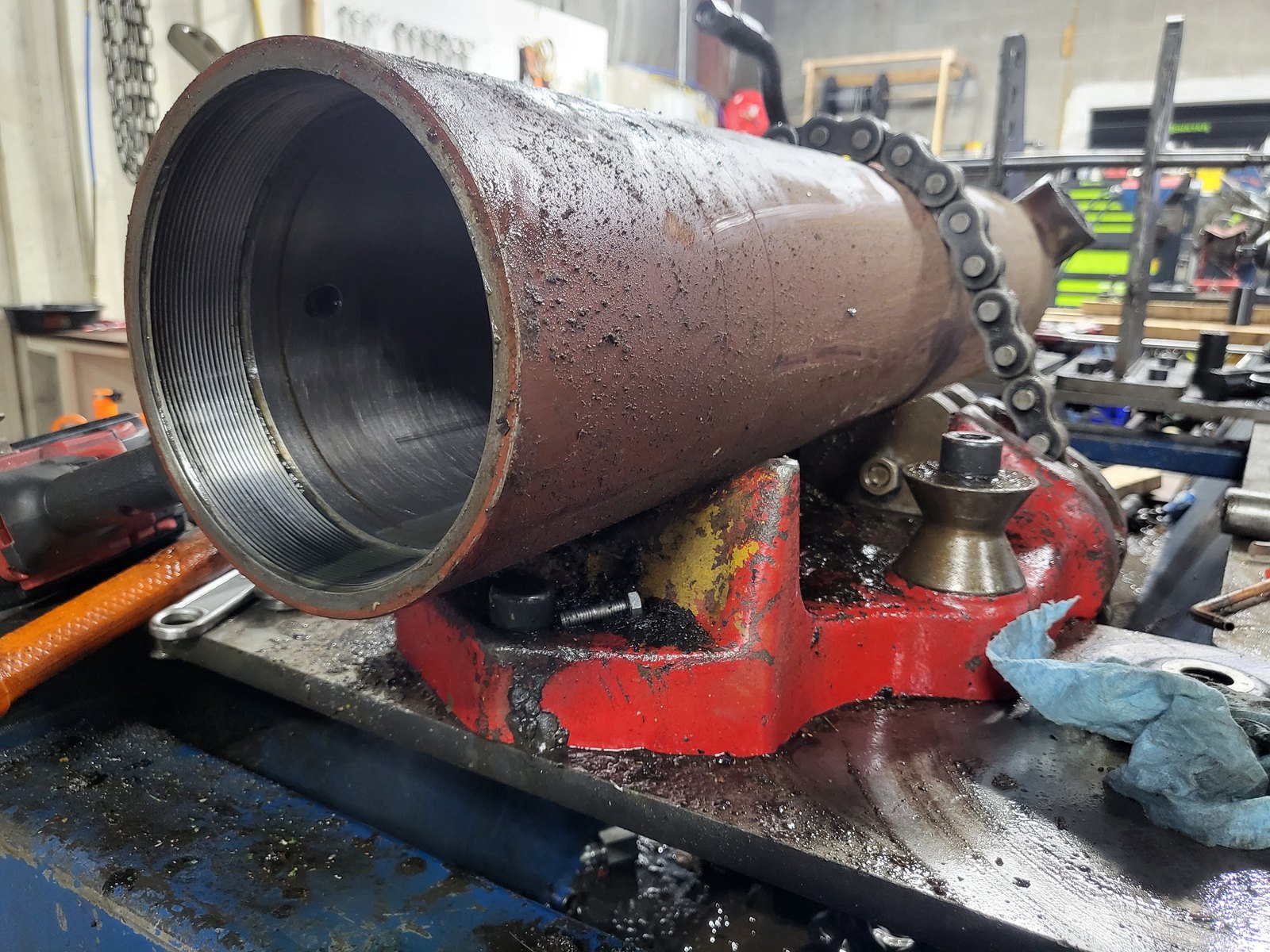
Most cylinder shops have a ceiling — a bore size, a rod length, a weight — where they start saying no. Ours sits a lot higher. Ames Hydraulics rebuilds large-bore, severe-duty hydraulic cylinders for the equipment classes where everything is oversized: mining equipment repair, marine and dredge hydraulics, military and defense-support equipment, and the heavy industrial rams that most of the market has never seen on a bench.
What Large-Bore Actually Demands
A big cylinder isn’t a small cylinder scaled up — it’s a different job. Handling alone separates the shops: rods and tubes that weigh more than a car need rigging, cribbing, and floor equipment most benches don’t have. Honing a large bore takes machine capacity and patience; packing a large gland takes seal sourcing beyond the catalog, and the big seals often come made-to-order with lead times worth planning around. Pressure testing a barrel-sized cylinder safely is its own discipline. We’ve built the shop around exactly this work — the same bench that rebuilt the closing ram on an industrial filter press the size of a school bus handles the cylinders off crushers, dredges, and drill rigs, with rod repair, re-chroming coordination, and machining in-house or through our specialist partners.
The Equipment Classes We Serve
- Mining and aggregate — crusher clamp and tramp cylinders, drill rig rams, dragline and shovel hydraulics, and the wider crusher work around them; underground Iowa is limestone and gypsum country, and the machines under it run hydraulics that never see daylight
- Marine and dredge — river dredge hydraulics, barge equipment, lock-and-dam adjacent machinery, and workboat systems off the Mississippi and Missouri corridors
- Military and defense support — severe-duty cylinders and hydraulic systems on support equipment, handled with the documentation the work requires
- Heavy industry — press rams, shear and baler cylinders, scrap handlers, and foundry equipment
- The one-off monsters — the cylinder nobody else will quote is usually the one we want to see
Repair Economics at This Scale
On ordinary cylinders, repair-versus-replace is a judgment call. At large bore, it almost never is: replacement lead times run months, freight alone costs thousands, and many big cylinders are semi-custom to begin with — which makes a proper rebuild the only answer that keeps the machine’s schedule. A typical large-bore rebuild — hone, seals, rod repair or re-chrome, pressure test to working spec — runs a fraction of replacement and turns in weeks, not quarters. For mining equipment repair and marine work, we’ll also tell you the honest scope split: cylinders, power units, and machining come to the shop; structural and system work happens at your site within our service range; and the exotic coatings or full re-tubes route through partners we’ve vetted, managed under one quote.
Start With the Nameplate
Big-cylinder jobs start with information: bore, stroke, rod diameter, and photos of the ports and mounts — nameplate if it exists, tape measure if it doesn’t. Text all of it to 515-292-2599 and we’ll tell you same-day whether it’s a straight rebuild, a rebuild with machining, or a job that needs engineering first. Freight and rigging can be arranged for the pieces that don’t travel on a pickup. 210 Freel Dr, Ames — Monday through Friday, 7AM to 5PM.
Iowa’s Underground: Closer Than People Think
Mining sounds like another state’s industry until you list what actually operates here: underground limestone mines across eastern and central Iowa, the gypsum operations at Fort Dodge, aggregate quarries in nearly every county, sand plants along the rivers, and the portable crushing spreads that move between them. All of it runs hydraulics in conditions that eat equipment — abrasive dust in every rod seal, water in every pit, and duty cycles that never let up. That’s the local reality behind our mining equipment repair work: drill rig feed and clamp cylinders, scaler and bolter hydraulics, loader and haul truck cylinders sized beyond what ordinary shops handle, and the pumps and power units behind them. For the underground operations, we work to your schedule and your safety systems — MSHA-aware, documented, and honest about which work belongs at our bench versus your site.
Common Large-Cylinder Questions
How big can you actually go? Tell us bore, stroke, and weight and we’ll answer specifically — the honest version is that our ceiling is far above the typical shop’s and below a dedicated OEM plant’s, and we know which jobs belong at each. My rod is scored — re-chrome or new rod? Depth decides: light scoring polishes out, moderate damage re-chromes through our plating partners, and deep gouges get a new rod machined — each quoted against the others so the math is visible. Can you come to the dredge/pit/site? Assessment and removal support within our range, yes; the precision work happens where the honing and test equipment lives. Military and government work — can you handle the paperwork? Documentation, traceability, and formal quotes are standard practice here, which is most of what that work requires. For any mining equipment repair or large-bore question, the nameplate photo texted to 515-292-2599 is the fastest start.
Related Services

Written by Josiah Ragsdale
Owner, Ames Hydraulics — Ames, Iowa
Josiah owns and operates Ames Hydraulics. He has worked on hydraulic and heavy equipment since he was 18, and every hydraulic cylinder his shop rebuilds is pressure tested before it ships back to the customer. More about Josiah →
Got something broken? Call or text 515-292-2599